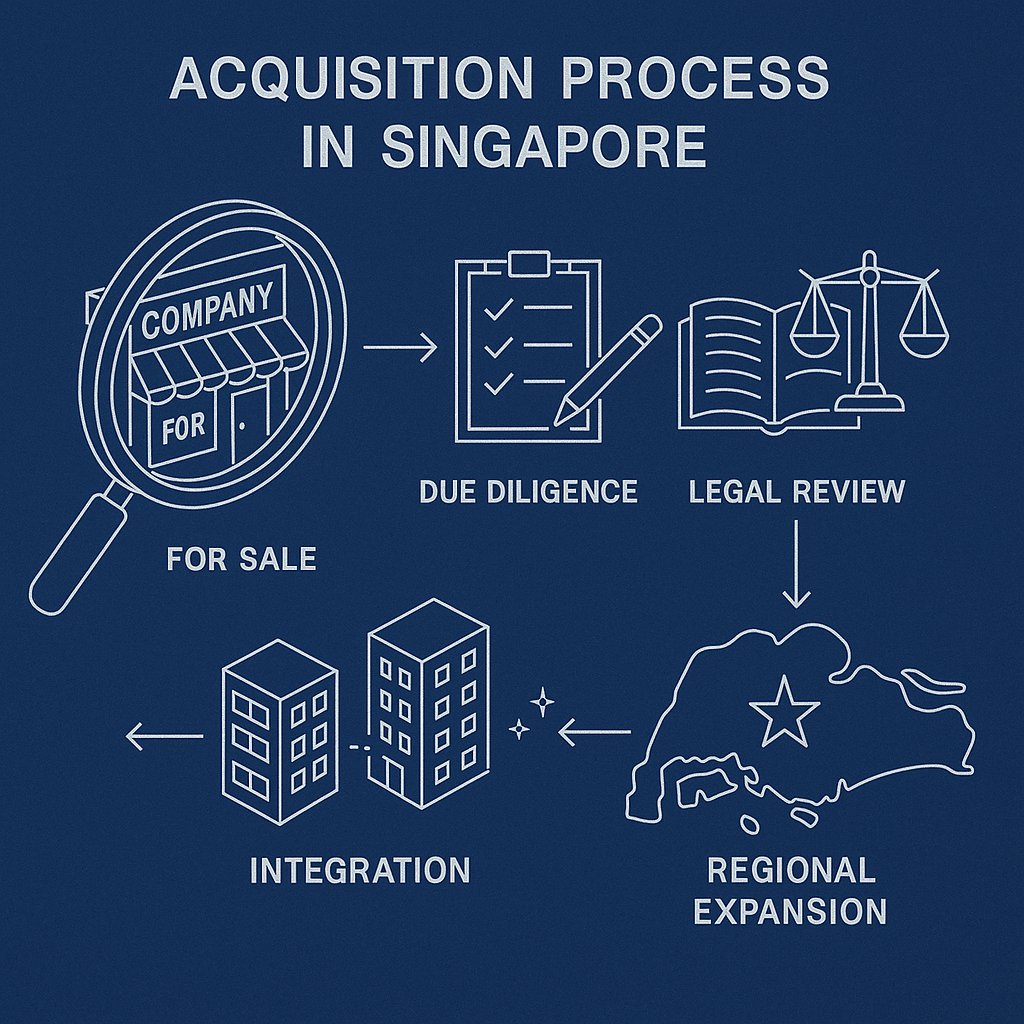
Overview: Why Acquiring in Singapore Is a Strategic Move, Not Just a Shortcut
1. Buying Proven Cash Flow in a Stable, Pro-Business Jurisdiction
2. Built-In Competitive Moats: Brand, Customers, and Intellectual Property
3. Portfolio Diversification and Non-Correlated Returns for Investors
4. Strategic Platform for ASEAN and Asia-Pacific Expansion
5. Plug-and-Play Capabilities: Systems, Talent, and Operational Know-How
6. Growth-by-Acquisition: Faster, More Controlled Scaling vs Organic Growth
7. Singapore-Specific Advantages: Legal Certainty, Investor Confidence, and Exit Options
8. How to Identify Strategic, Not Just Cheap, Businesses for Sale in Singapore
FAQ: Buying a Business for Sale in Singapore as a Strategic Investor
Conclusion: Treat Acquisition as a Long-Term Strategic Engine, Not a Shortcut
Work with Bizlah
Overview: Why Acquiring in Singapore Is a Strategic Move, Not Just a Shortcut
Expert Insight:
According to aemorph.com, Singapore remains a top choice for starting or scaling a business thanks to its low flat corporate tax rate of 17%, no capital gains tax, and additional targeted tax incentives for certain industries and startups, all of which encourage reinvestment and expansion ([source](https://aemorph.com/en-sg/singapore/business/)). The site also notes that Singapore permits 100% foreign ownership, allowing international entrepreneurs and corporations full control without needing local partners. (aemorph.com)
When most people look at a business for sale in Singapore, they focus on speed-to-market: buy now, start operating tomorrow. Learn more: Sell or Buy a Business.That speed matters, but it is only one part of the story.
For serious entrepreneurs and investors, acquisition in Singapore can be a deliberate strategy to strengthen cash flow, reduce risk, gain capabilities you cannot build easily, and secure a platform for regional expansion. Singapores pro-business environment, strong financial ecosystem, and talent pool magnify these benefits.
This article focuses on the deeper, longer-term advantages of buying a business in Singaporehow a carefully chosen acquisition can improve your portfolio, sharpen your competitive edge, and position you for scalable growth across Asia-Pacific.
1. Buying Proven Cash Flow in a Stable, Pro-Business Jurisdiction
Instead of funding a speculative startup, acquiring a business in Singapore lets you buy a track record. You are not just purchasing assets; you are acquiring a live economic engine that already operates within one of the worlds most stable business environments.
Key strategic upsides:
Visible revenue and profit history:You can analyse past financials to gauge resilience across economic cycles, unlike a greenfield venture where projections are purely hypothetical. Guides such as those from Aviaan Accountinghighlight how financial due diligence helps buyers validate sustainable performance.
Lower regulatory uncertainty:Singapores clear corporate and tax rules, along with predictable enforcement, reduce the risk of unpleasant surprises post-acquisition. Resources from firms like Yuen Lawemphasise the importance of aligning deal structure with local regulations.
Tax-efficient profit retention:A flat corporate tax rate of 17% and no capital gains tax on the sale of capital assets (as widely noted in market guides) mean more profits stay in the business for reinvestment, dividends, or further acquisitions.
Access to a mature banking and capital market:Singapores strong financial ecosystem, with extensive banking and financing options, supports refinancing, working capital optimisation, and M&A-backed growth.
For investors comparing asset classes, an operating business with proven earnings in a jurisdiction like Singapore can complement or outperform traditional equities, especially when you actively improve operations and margins rather than simply invest and hope.
2. Built-In Competitive Moats: Brand, Customers, and Intellectual Property
A well-chosen business for sale in Singapore often comes with entrenched competitive advantages that would take years and substantial capital to replicate from scratch.
Strategic assets you can acquire on Day 1:
Brand equity and reputation:In sectors like B2B services, F&B, education, and health, trust is a major barrier to entry. An established brand with social proof, reviews, and word-of-mouth allows you to build on existing goodwill instead of burning cash on awareness.
Customer base and contracts:Long-term contracts, recurring subscriptions, and repeat buyers offer immediate revenue visibility. This is especially valuable in Singapores concentrated industries where customer churn is expensive.
Supplier and distribution relationships:Preferred pricing, exclusivity agreements, and long-standing arrangements can be decisive moats. Replacing these relationships from scratch is both time-consuming and uncertain.
Intellectual property and know-how:As legal advisors such as Yuen Law highlight, IPincluding trademarks, copyrighted materials, proprietary processes, software, and trade secretscan be central to a companys long-term profitability. Buying an IP-rich business in Singapore gives you:
Defensible differentiation in regional markets.
Licensing and royalty opportunities.
Leverage for future fundraising and valuations.
During due diligence, it is critical to validate ownership of IP, confirm licence terms, and check for potential infringement risks. Done correctly, you are not only buying present income, but a moat that compounds value over time.
3. Portfolio Diversification and Non-Correlated Returns for Investors
For investors used to stocks, bonds, and funds, acquiring a private operating business in Singapore can be a meaningful diversification move. Local personal finance resources such as SingSaverregularly emphasise diversification across asset classes and geographies; a Singapore-based business fits that strategy well.
Why a privately held business changes your portfolio profile:
Lower correlation with public markets:A well-managed SME does not necessarily move in lockstep with global indices or the performance of the best performing stocks. Earnings may be more anchored to local demand, contracts, and niche segments.
Active control vs passive exposure:Unlike listed equities or REITs, you can influence strategy, operations, and capital allocation. This control can materially improve returns if you bring in new capabilities or networks.
Exposure to Singapores macro strengths:Analyses by firms such as Beaufortand CSC Globalconsistently highlight Singapores political stability, strong legal system, and open trade policies. Owning a business here gives you direct exposure to those tailwinds.
Alternative investment dimension:Compared with other alternative investments(e.g., private equity funds, real assets), controlling a single or small group of businesses lets you tailor risk levels, leverage, and exit timing to your own objectives.
If you already hold public-market exposure in Singapore or the region, an operating business can serve as both a hedge and a high-conviction growth play, provided you approach the deal with institutional-grade discipline.
4. Strategic Platform for ASEAN and Asia-Pacific Expansion
Singapore is widely viewed as a launchpad into broader Asia-Pacific markets. By acquiring a business here, you do not simply buy local presence; you acquire a base that can be scaled into regional operations.
How Singapore amplifies the value of your acquisition:
Gateway to ASEAN consumers:With its strategic location and network of free trade agreements and double tax treaties, Singapore is a natural hub for serving ASEAN and wider APAC markets. Many global firms use Singapore-based entities to manage regional operations, logistics, and cross-border tax structuring.
Infrastructure and connectivity:World-class port and airport facilities, coupled with efficient logistics, let you turn a local business into a regional distribution or sourcing hub. Digital infrastructure and data connectivity also support cross-border digital services and e-commerce.
Talent and language advantages:A bilingual workforce proficient in English and regional languages (Mandarin, Malay, Tamil, and others) makes cross-border sales, procurement, and support much easier.
Supportive government programs:Enterprise Singapore and related agencies provide grants and schemes to help local companies internationalise. Initiatives such as the Enterprise Development Grant can co-fund market expansion, process improvements, and innovation projects.
When reviewing any business for sale in Singapore, evaluate not only its local strength but also its option value: How easily can this company extend into Malaysia, Indonesia, Vietnam, Thailand, or beyond with the right capital and leadership?
5. Plug-and-Play Capabilities: Systems, Talent, and Operational Know-How
A big advantage of acquisition over a fresh start is the plug-and-play nature of capabilities you obtain. You are buying more than revenue; you are buying a functioning machine.
Operational assets that accelerate your strategic plans:
Experienced teams:Skilled staff, management, and specialists already trained on the companys processes reduce your execution risk. In Singapores tight labour market, inheriting an aligned team is a major edge.
Documented processes and playbooks:Standard operating procedures, compliance frameworks, and quality controls help you maintain service levels while you test new strategies.
Technology stacks and data:Many businesses now run on integrated systems (ERP, CRM, marketing automation, analytics). Acquiring a company with strong digital foundations lets you layer on AI, data science, or automation much fastereading industry reports, such as PwCs analyses on AI adoption and transformation, highlight how data-rich organisations move faster than those building from zero.
Licences and certifications:Operating licences, industry certifications, and regulatory approvals can be hard to obtain and maintain. Buying a licensed entity gives you a running start.
These capabilities are particularly attractive if you already own other businesses. You can transfer best practices across your portfolio, cross-staff teams, and centralise certain functions (finance, marketing, HR, tech) to create group-level economies of scale.
6. Growth-by-Acquisition: Faster, More Controlled Scaling vs Organic Growth
Global consulting and transformation frameworks, such as those discussed in PwCs growth vectorseries, treat acquisitions as one of the core levers for scaling. In Singapores compact but sophisticated market, M&A is often a more efficient way to scale than organic expansion.
Strategic scaling advantages when you buy instead of build:
Faster market share gains:Rather than fighting incumbents for every customer, you can purchase competitors or complementary players and consolidate market share.
Capability and product expansion:Acquiring targets with new product lines, technologies, or channels lets you broaden your offering without starting long R&D or hiring cycles.
Synergy and cost optimisation:Overlapping functions (back office, marketing, logistics) can be consolidated, improving margins. Methods used in consumer and tech sectors, as described in reports like PwCs CPG growth playbooks, are highly relevant to SMEs in Singapore as well.
Defensive plays:Buying a potential disruptor or key supplier can protect your core business from future threats, especially in fast-changing sectors such as digital services, logistics, or technology-enabled niches.
By building a small group of complementary companies in Singapore, you can create a platform that is significantly more valuable than the sum of individual businessesand more attractive to future strategic buyers or financial investors.
7. Singapore-Specific Advantages: Legal Certainty, Investor Confidence, and Exit Options
Acquisitions are ultimately judged by risk-adjusted returns. Singapore raises the floor on risk while widening your exit pathways.
Legal and regulatory clarity:
Legal guides from firms such as WLP Groupand Rikvin/RSBUunderscore how clear corporate, tax, and IP regimes support both local and foreign buyers.
100% foreign ownership is allowed in most sectors, removing the need for complex nominee structures and giving investors full control over their acquisitions.
High credibility with global counterparties:
Being based in Singapore tends to increase trust among international customers, suppliers, and financiers due to the countrys reputation for governance and contract enforcement.
This reputational premium can improve your ability to win regional deals and negotiate more favourable terms.
Diverse exit strategies:
You can sell to strategic buyers (local or foreign), private equity funds, family offices, or other entrepreneurs seeking a proven foothold in Singapore.
In some cases, you can position for an eventual listing or partial stake sale, especially if you scale through roll-ups or regional expansion.
By entering Singapore through acquisition, you embed your capital in an ecosystem that supports long-term liquidity, not just paper gains.
8. How to Identify Strategic, Not Just Cheap, Businesses for Sale in Singapore
Not every listing is a strategic fit. The real value comes from alignment with your capabilities, risk appetite, and long-term plan.
What to look for when scanning listings and deals:
Clear, defensible niche:Prefer businesses with a well-defined customer segment or specialised capability rather than generic me-too offerings.
Healthy unit economics:Gross margins, customer acquisition cost, churn, and working capital cycles matter as much as top-line revenue.
Transferable IP and contracts:Verify that key IP, software, licences, and contracts can legally be transferred to you as the new owner.
Operational resilience:Review how the business weathered shocks (pandemic, supply chain issues, regulatory changes). Stability signals stronger fundamentals.
Scalability and synergy potential:Ask whether the business can grow meaningfully with better systems, capital, or cross-selling with other assets you own.
Marketplaces such as BusinessForSale.sgprovide a wide range of listings across sectors. Use them for deal flow, but filter opportunities through a strategic lens, not just headline asking prices.
If you want structured guidance and a more curated view of opportunities, you can also work with a specialist business brokerwho understands both Singapore regulations and investor-level strategy.
FAQ: Buying a Business for Sale in Singapore as a Strategic Investor
Q1: Is buying a business for sale in Singapore better than starting from scratch?
It depends on your goals and risk profile, but strategically, acquisition often wins when you value speed, existing cash flow, and built-in capabilities. You gain customers, staff, brand, systems, and regulatory approvals on Day 1, reducing execution risk compared with building everything from zero.
Q2: Can foreign investors fully own a business they acquire in Singapore?
Yes, in most industries foreign investors can own 100% of a Singapore company. This is one reason the country is consistently highlighted as attractive in investor-oriented guides from firms like Beaufort and CSC Global. Certain regulated sectors may have extra rules, so always verify with local legal counsel.
Q3: How does an acquisition in Singapore fit into a diversified investment portfolio?
A privately held Singapore business can provide non-correlated returns compared with traditional stocks and bonds. It gives you active control over performance, exposure to Singapores stable economic environment, and the potential for value creation through operational improvements and regional expansion.
Q4: What are the biggest strategic risks when buying an existing business?
Key risks include overpaying for goodwill, undisclosed liabilities, weak or non-transferable IP, over-reliance on a few key customers or founders, and cultural misalignment post-acquisition. This is why thorough due diligence on finances, legal matters, and operations is essential, as emphasised in professional guides by accounting and law firms in Singapore.
Q5: How do I know if a specific business for sale in Singapore has regional expansion potential?
Look for products or services with cross-border relevance, existing overseas customers, scalable systems, and a brand or capability that can travel well to other ASEAN markets. Also check whether its supply chain, regulatory requirements, and talent needs can realistically be extended into neighbouring countries.
Q6: Are government grants available to businesses acquired by new owners?
Many Enterprise Singapore grants and support schemes are company-based rather than founder-based, so a change in shareholding does not automatically disqualify the company. However, eligibility depends on factors such as company size, project scope, and sector. You should review current guidelines and, if needed, consult a grant consultant or corporate advisor.
Conclusion: Treat Acquisition as a Long-Term Strategic Engine, Not a Shortcut
Buying a business for sale in Singapore is far more than a way to get in quickly. When approached strategically, it lets you acquire proven cash flow, built-in moats, operational capabilities, and a powerful base for regional expansionall within a jurisdiction that investors worldwide trust.
Whether you are an entrepreneur seeking your next operating company or an investor looking for higher-conviction alternative assets, Singapore offers a unique combination of legal certainty, infrastructure, and growth potential. The key is to move beyond opportunistic bargain-hunting and treat each deal as part of a deliberate, long-term strategy: diversify your portfolio, build synergies, and design clear pathways to future exits.
With disciplined due diligence, thoughtful structuring, and a clear growth thesis, your next Singapore acquisition can become not just another investment, but a cornerstone asset in your entrepreneurial or investment journey.