
SME Valuation in Singapore (2025): What Drives Price, Proof, and Buyer Confidence in Real Deals
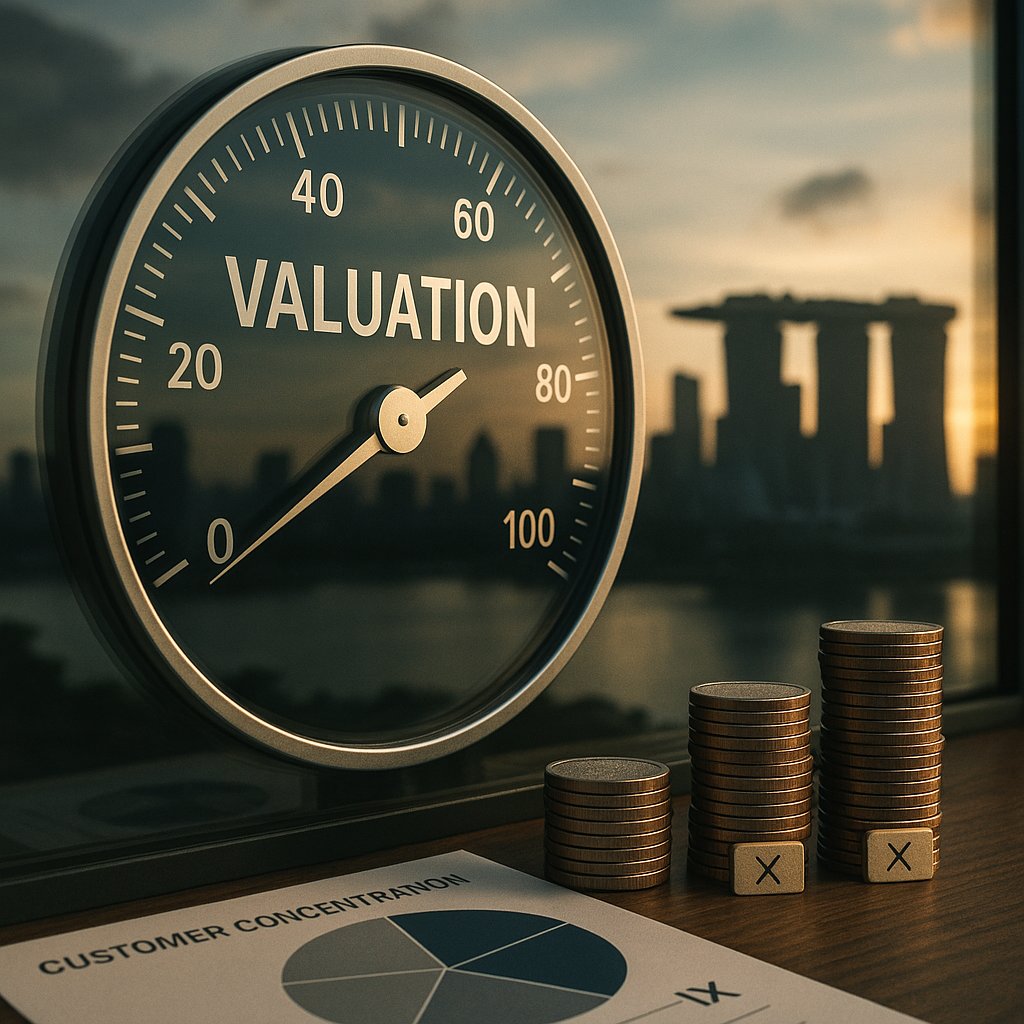
Table of Contents
- Overview: Valuation in 2025 is a Risk Question, Not Just a Number
- What Actually Drives Price: Earnings Quality, Recurrence, and Concentration Risk
- Proof Buyers Pay For: Due Diligence Evidence That Reduces Discounting
- Intangible Assets in Singapore SMEs: The Hidden Premium (If You Can Substantiate It)
- Buyer Funding, Deal Structure, and Why “Financeability” Changes Valuation
- Conclusion: Raise Valuation by Making the Business Easier to Believe
- FAQ
- Work with Bizlah
Overview: Valuation in 2025 is a Risk Question, Not Just a Number
Expert Insight: According to www.ipos.gov.sg (https://www.ipos.gov.sg/news/news-collection/why-identifying-and-valuing-intangible-assets-is-good-for-business/), analysts said PropertyGuru’s roughly 52% acquisition premium in EQT’s December 2024 all-cash deal (valuing it around US$1.1 billion) reflected the strength of its intangible assets such as its proprietary platform, brand recognition, and marketplace network effects. The source recommends that businesses not only identify intangible assets but also assess and value them to better understand and unlock their growth potential, especially since their value often becomes apparent during M&A. (www.ipos.gov.sg)
In 2025, SME valuation in Singapore is best understood as a buyer’s pricing of risk: revenue durability, cost control, customer concentration, and how quickly confidence can be built during due diligence. Learn more: Sell or Buy a Business.Sellers often focus on “what the business is worth,” while buyers focus on “what can go wrong after completion” and discount price accordingly.
That is why two SMEs with similar profits can trade at very different valuations. The differentiator is the quality of proof: clean accounts, credible forecasts, well-documented operations, and defensible intangible assets that can be transferred to a new owner without revenue dropping.
If you are preparing a business for sale in singapore, a practical goal is to reduce unknowns: show stable cash generation, prove what drives demand, and document what a buyer must do to keep performance consistent.
What Actually Drives Price: Earnings Quality, Recurrence, and Concentration Risk
Most SME deals still anchor on cash flow (often using EBITDA or seller’s discretionary earnings), but buyers increasingly adjust for earnings quality. The valuation multiple rises when profits are repeatable and not overly dependent on the owner.
- Recurring revenue and renewal dynamics: Subscriptions, service contracts, and repeat B2B purchase cycles reduce volatility and support stronger pricing.
- Customer and supplier concentration: Heavy reliance on a few customers or one key supplier is usually priced as risk, even if current results look strong.
- Margin resilience: Buyers test whether gross margins are protected by differentiation, switching costs, or pricing power rather than short-term promotions.
- Working capital intensity: Businesses that require heavy inventory or extended receivables can look profitable but produce weak cash conversion.
- Owner dependence: If the founder personally closes sales, manages vendor relationships, or holds the only operational know-how, buyers will discount unless a transition plan is credible.
Macro conditions matter too. Singapore’s growth outlook and sentiment can influence buyer appetite and financing availability, affecting achievable multiples in the broader market. You can reference Singapore’s GDP trend as context when discussing timing and risk in a sale process: https://tradingeconomics.com/singapore/gdp.
Proof Buyers Pay For: Due Diligence Evidence That Reduces Discounting
Buyer confidence is built with documentation. The best valuation outcomes typically come from sellers who can answer diligence questions with files, not explanations. Treat this as building an “audit trail” that links performance to verifiable drivers.
- Financial proof: Management accounts that tie out to bank statements and tax filings; clear normalization of one-offs; consistent revenue recognition policies.
- Commercial proof: Customer contracts, renewal history, pipeline reports, pricing lists, churn data, and evidence of marketing ROI.
- Operational proof: SOPs, staff role clarity, key KPIs, vendor agreements, and evidence that the business runs without constant owner intervention.
- Legal and compliance proof: Licences, leases, IP ownership/assignments, data protection practices, and a clean record of disputes.
Advisory frameworks often emphasize value creation before a sale and disciplined execution during uncertainty; both themes map to strengthening evidence and reducing execution risk in the buyer’s eyes. See PwC’s perspectives on value creation and selling in uncertain conditions: https://www.pwc.com/ca/en/services/deals/value-creation.html and https://www.pwc.com/ca/en/services/deals/navigating-your-sale-in-uncertainty.html.
Intangible Assets in Singapore SMEs: The Hidden Premium (If You Can Substantiate It)
Many SME buyers say they want “a strong brand” or “a proprietary system,” but they only pay a premium when the intangible is identifiable, protected, and demonstrably linked to cash flow. In practice, this is where valuation gaps arise: sellers assume goodwill; buyers demand defensibility.
- Brand and market position: Show measurable awareness, conversion rates, and repeat purchase behaviour attributable to brand trust.
- Technology and proprietary workflows: Document what is owned versus licensed, and how systems increase margin, retention, or speed.
- Data, processes, and know-how: Demonstrate how playbooks, training, and datasets reduce ramp-up time for new staff and new owners.
- Network effects and partnerships: Evidence of preferential terms, exclusive arrangements, or ecosystem positioning that a buyer can inherit.
Singapore’s IP ecosystem encourages businesses to identify and value intangible assets systematically. For practical guidance on why this matters and how it supports business outcomes, refer to IPOS: https://www.ipos.gov.sg/news/news-collection/why-identifying-and-valuing-intangible-assets-is-good-for-business/.
Real-market examples also show premiums being attributed to intangibles. When EQT acquired PropertyGuru in an all-cash deal at a significant premium, analysts highlighted intangible strengths such as platform capability, brand recognition, and network effects. While SMEs are not listed companies, the principle is the same: prove the intangible and tie it to earnings durability.
Buyer Funding, Deal Structure, and Why “Financeability” Changes Valuation
In 2025, valuation is influenced by how easily a buyer can fund the acquisition and service debt without straining the business. A “financeable” SME can command better pricing because more buyers can compete, timelines shorten, and closing risk falls.
- Loan-readiness: Clean statements, stable cash flow, and sensible add-backs make it easier for buyers to obtain SME financing. Buyers often compare options across banks and platforms; an overview of SME loan considerations can be found here: https://www.singsaver.com.sg/personal-loan/blog/best-sme-business-loans-in-singapore.
- Government support and capability upgrading: Grants that improve productivity, digitisation, and market expansion can strengthen future performance, but buyers will still check whether benefits are ongoing and transferable. For an overview of common SME grants and how they support growth, see: https://www.moneydigest.sg/sme-grants-in-singapore-to-support-your-business/.
- Deal terms that bridge valuation gaps: Earn-outs, vendor financing, and retention bonuses can raise headline value while protecting the buyer if performance dips post-completion.
- Market climate and policy signals: Business sentiment can be shaped by Budget priorities and recommendations. For current themes around competitiveness and strategy, see KPMG’s Budget 2025 coverage: https://kpmg.com/sg/en/media/press-releases/2025/01/kpmg-and-sid-unveil-budget-2025-recommendations.html and https://kpmg.com/sg/en/media/press-contributions/2025/02/budget-2025–a-strategic-blueprint-for-a-new-era.html.
Where you list and who represents you also affects buyer confidence. Serious buyers often scan established marketplaces and compare similar listings, then engage brokers for screening and process management. For examples, see: https://www.businessforsale.sg/businesses-for-sale and https://www.businessforsale.sg/business-brokers.
For seller teams managing reporting and diligence, specialist support can help standardise performance packs and speed buyer verification. Explore MarktoMarket support to improve deal readiness and investor-grade reporting.
Conclusion: Raise Valuation by Making the Business Easier to Believe
In Singapore’s 2025 market, the strongest SME valuations go to sellers who make performance easy to verify and easy to transfer. Price is driven by cash flow, but the multiple is driven by risk: customer concentration, owner dependence, cash conversion, and the credibility of your documentation.
If you are preparing a business for sale in singapore, focus on three outcomes: (1) prove earnings with clean reconciliations and sensible normalization, (2) substantiate intangible assets with ownership and impact evidence, and (3) improve financeability with predictable cash flow and disciplined reporting. Do that well, and you do not just ask for a higher valuation—you make it rational for buyers to pay it.
FAQ
Q: What valuation methods are most common for Singapore SMEs in 2025?
A: Most deals triangulate between an earnings multiple (often based on normalised EBITDA), a discounted cash flow check, and market comparables from similar local transactions. Buyers typically anchor on sustainable cash flow and then adjust for concentration risk, working capital needs, and growth reliability.
Q: What evidence helps buyers trust your revenue and margin quality?
A: Buyers look for clean monthly management accounts that tie to bank statements, GST filings, and audited financials where available. Cohort/retention data, signed customer contracts, and clear pricing history help prove repeatability and reduce “one-off” earnings concerns.
Q: How do customer concentration and key-person risk affect valuation in Singapore deals?
A: High reliance on a few customers or one founder usually lowers the multiple because continuity looks fragile. Long-term contracts, diversified customer mix, documented SOPs, and a second-tier management team can directly improve buyer confidence and pricing.
Q: Which intangible assets can lift an SME valuation, and what proof is needed?
A: Defensible intangibles include proprietary processes, software, licenses, brand strength, and exclusive supplier/customer arrangements. The uplift comes when these are documented—IP registrations where relevant, enforceable agreements, and metrics showing they drive conversion, retention, or pricing power.
Q: What deal documents most influence buyer confidence and speed to close?
A: A well-structured data room with a clear quality-of-earnings bridge, customer/supplier contracts, employee terms, and cap table/shareholder records reduces diligence friction. Clear working capital assumptions, earn-out logic (if any), and a credible post-sale transition plan also help buyers commit faster.
Related Reading
Work with Bizlah
consultative CTA — explore Sell or Buy a Business.
- Local expertise in Singapore
- End-to-end guidance
- Transparent valuation
Informational only; not financial advice.